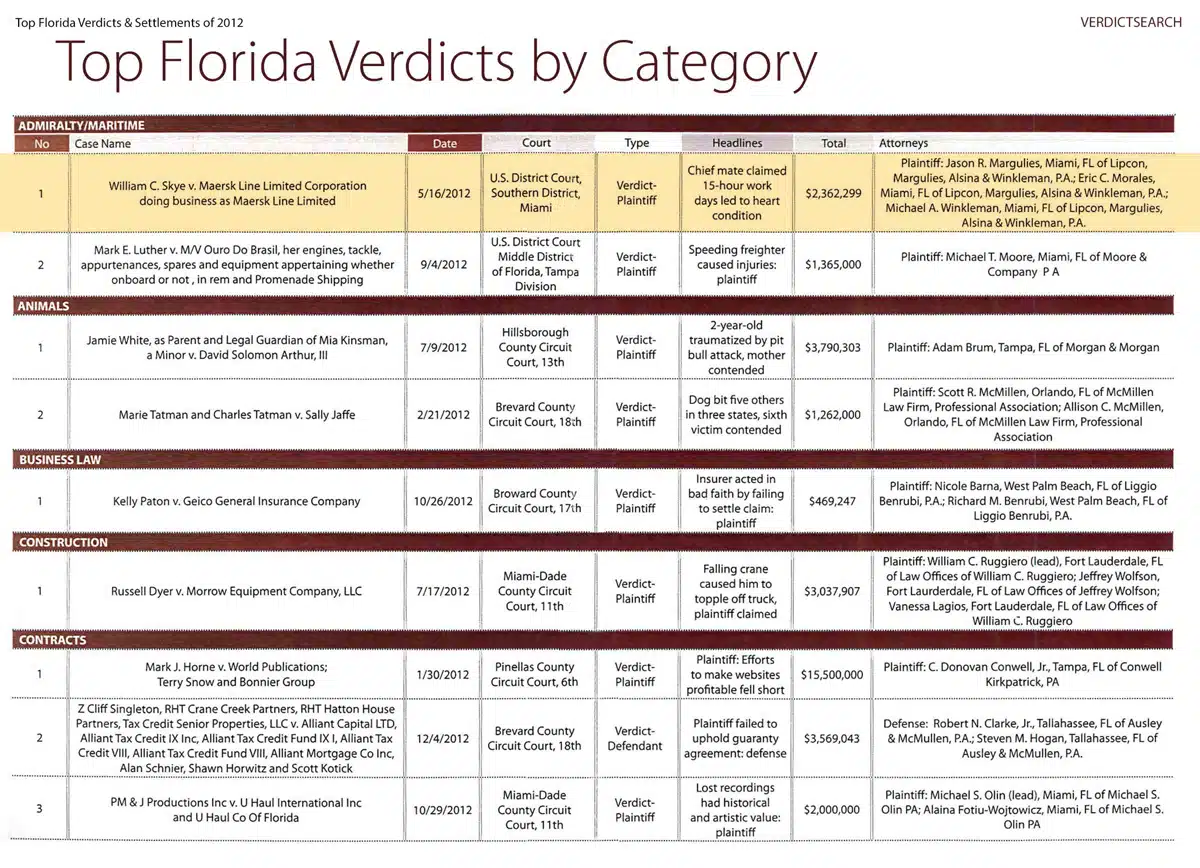




$2,362,299 Verdict Against Maersk for Overworked Chief Mate
Working at sea demands an enormous physical and mental toll, and federal maritime law exists precisely to protect seafarers from employers who treat endurance as a substitute for safety. When a shipping company forces crew members to work excessive hours without adequate rest, the consequences can be permanent, as William Skye’s case against Maersk makes painfully clear. Skye spent eight years working grueling 15-hour days as a Chief Mate aboard a Maersk container vessel. The cumulative stress and fatigue caused him to develop labile hypertension, a serious heart condition that became apparent only after an echocardiogram revealed permanent damage in 2008.
At Lipcon, Margulies & Winkleman, P.A., we represented Skye in this landmark case, securing a $2,362,299 verdict under the Jones Act on May 16, 2012. The Daily Business Review, which ranks and publishes Florida Top Verdicts, reported the outcome. Our firm has over 250 years of combined experience handling maritime and admiralty claims on behalf of passengers and crew members injured at sea, and this case reflects exactly the kind of aggressive, results-driven representation we bring to overworked seamen’s claims.
Who Is Maersk?
Maersk is one of the largest shipping conglomerates in the world, operating a massive fleet of container ships that traverse international waters. Despite its vast resources, Maersk was found to have imposed dangerous working conditions on crew members aboard the Sealand Pride, a commercial container vessel. During Skye’s employment, the company failed to provide mechanized aids for carrying or moving heavy equipment, failed to train its workers properly, and failed to maintain a safe working environment. Critically, Maersk was aware that onboard conditions posed safety hazards and took no steps to address or mitigate them.
When a corporation of that size fails to honor a dedicated crew member after eight years of service, the damage is real, and the accountability must be proportionate. Maersk’s negligence was not a single oversight. It was a sustained failure that directly caused Skye’s occupational heart disease.
What the Jones Act Protects
The Jones Act is a federal law that allows seamen injured by employer negligence to pursue compensation for their injuries. Because Skye worked aboard a vessel in navigable waters and spent the vast majority of his time onboard the Sealand Pride, he qualified as a seaman under the Act. Under the Jones Act, an injured seafarer may be eligible to recover damages for injuries, disability, and lost wages caused by a failure to provide a reasonably safe work environment.
Filing a Jones Act claim requires meeting specific legal standards and deadlines, which is why working with an attorney who focuses exclusively on maritime law is essential. It is also worth noting that federal regulations mandate a minimum of 10 hours of rest within any 24 hours for watchkeeping personnel, underscoring that Skye’s 15-hour workdays were not only unreasonable but also in violation of federal maritime safety standards.
How Lipcon, Margulies & Winkleman, P.A. Successfully Proved Negligence
Our attorneys successfully demonstrated that Maersk acted negligently by forcing Skye to work beyond his physical capacity for an extended period. The demands of his position as Chief Mate, combined with the excessive hours and lack of rest, caused him to suffer persistent stress, fatigue, and heart palpitations throughout his time aboard the Sealand Pride. After he signed off the vessel in 2008, an echocardiogram confirmed permanent physical injuries to his heart.
The case turned on proving that Maersk knew about the hazardous conditions and failed to act, that the company withheld tools and resources that could have reduced physical strain, and that Skye’s injuries were directly linked to those conditions. The burden of proof on the shipowner in maritime negligence cases favors injured crew members more than many workers may realize. Unlike traditional workers’ compensation frameworks, the Jones Act allows an employer’s negligence to be a partial, not the sole, cause of injury for a claim to succeed.
What Damages May Be Recovered in a Seafarer’s Rights Claim
Skye’s $2,362,299 verdict reflects the range of compensation available to injured seamen under the Jones Act. Depending on the facts of a case, recoverable damages may include:
- Medical expenses, including diagnostic testing such as the echocardiogram that confirmed Skye’s heart condition
- Lost wages and reduced earning capacity
- Pain and suffering
- Disability resulting from occupational disease or physical injury.
The outcome in Skye’s case is part of a broader record of success you can review on our case results page. It is important to understand that the Jones Act statute of limitations requirements are strict, and waiting to consult an attorney may affect your ability to recover.
Ready to Hold Your Employer Accountable? Contact Lipcon, Margulies & Winkleman, P.A.
Lipcon, Margulies & Winkleman, P.A. was founded in 1971 and has recovered well over $500 million for injured maritime clients across more than 4,000 cases. We are the only plaintiffs maritime firm in the United States to be named in “Best Law Firms”® by US News & World Report at the national level, and five of our attorneys have been named “Best Lawyers”® by the same publication. Two of our named partners have been recognized as “Lawyer of the Year”® in Admiralty and Maritime Law by US News & World Report. With 19 attorneys across 7 offices, we have the depth and focus to take on well-resourced defendants like Maersk and hold them accountable.
If you are a seafarer who has been injured or made ill due to unsafe working conditions imposed by your employer, you may have a right to compensation under the Jones Act. Call us at 877-233-1238 or reach out through our free case evaluation form to speak with one of our maritime lawyers. Let us put our experience to work for you.